
Life Beyond the Code
30 non-technical lessons for software engineers—on mindset, relationships, career, and life outside the 9-to-5. The stuff no one teaches you in code, and what shaped my career more than any framework

I spent years measuring myself in commits. Lines written. Bugs closed. Pull requests merged.
It is a clean way to keep score. It is also a trap.
The work taught me to code. Life taught me the rest. And the rest, it turns out, matters more.
Here is what I learned outside the IDE. None of it is technical. All of it shaped my career more than any framework did.
Mind
1. Code is not happiness.
Your worth is not your output. A great commit feels good. It does not feed you. Happiness comes from a life, not a log. I learned this the hard way, late.
2. Learn to say no.
No is a complete sentence. Say it to meetings that do not need you. Say it to requests that pull you off your path. I have said no to close friends asking me to hang out. The real ones understood. Your attention is the asset. Guard it.
3. Offline is the new luxury.
The screen will always be there. The walk will not. Step away. Touch grass, as the kids say, but mean it. Every burnout I have dodged, I dodged by logging off.
4. Mondays are not the villain.
Every day can be hard. Every day can be good. The difference is your head, not the calendar. Monday just has bad PR.
5. Take the break.
Five minutes from the screen returns more than it costs. Walk. Get chai. Catch the office gossip. The mind solves problems when you stop staring at them.
People
6. Make friends outside tech.
Engineers talking to engineers is an echo. A lawyer, a doctor, a designer — they see the world from angles you cannot reach from your desk. My best conversations rarely mention JavaScript. That is the point.
7. Make friends, not connections.
Networking is a real skill — go to the events, join the communities, show up to the meetups. Open source programs like GSoC put me in rooms I had no other way into. But a contact list is not a circle. Networking opens doors; friendship is who walks through them with you. Chase the people who would help you move apartments, not just like your LinkedIn post.
8. Help your peers.
Give your knowledge away. A team that lifts each other rises together. And one day you will break production at 2 a.m. You will want teammates who remember you were kind.
9. Unblock people fast.
If someone is stuck waiting on you, you are the bottleneck. Clear it first. Momentum is fragile, and trust is built in moments like these.
10. There is no quick call.
The quick call is a myth. It always runs long. If it is not urgent, write it down instead. Async respects everyone’s time, including yours.
Career
11. Your name is your homepage.
People will Google you before they meet you. Make the results worth finding. Share your work. Write. Build in the open. GitHub is my real résumé. A strong public trail opens doors a CV cannot.
12. You work for people, not logos.
The name on the offer letter fades. The manager and the team decide your days. I have learned from a Postman cofounder and now build alongside people far smarter than me. My impostor syndrome is thriving. So is my growth. Pick the people.
13. Keep your CV ready.
The worst time to update it is when you need it. Treat it as a living thing, not an emergency document. Opportunity does not schedule itself.
14. Teach what you know.
You learn a thing twice when you explain it once. Write the post. Help the junior. Open source is the largest classroom there is — your code keeps teaching while you sleep.
15. Keep learning.
Blink and you are three frameworks behind. Yesterday’s cutting edge is today’s legacy. Stay curious or fall quietly behind.
16. Do not fear a new language.
Loyalty to one language is one job switch away from a crisis. Real growth starts when you stop saying “I’ll never touch that” and start asking how to write a loop in Rust.
17. Read the news. Watch the feed.
The industry moves fast. Tech news and Tech Twitter are where its pulse lives. Follow the sharp people. Absorb. Then get back to work.
18. Write to think.
You do not know what you think until you write it down. Writing is where fuzzy ideas go to become clear or fall apart. Write the design doc, the decision, the postmortem — even if no one reads it—the act of forming the sentence forces the thought.
19. Learn to negotiate.
No one teaches you this, and it quietly decides your salary, scope, and title. The offer is a starting point, not a verdict. Ask. The worst case is a no, and you were already there. One uncomfortable conversation can outearn a year of raises.
20. Show up in person.
Hackathons and meetups look like swag and competition. You leave with friends, ideas, and the urge to build. The room changes you more than the prize.
Work
21. Plan tomorrow tonight.
A short list before you log off gives the morning direction. Find the 20% that drives 80%, and start there. I still write mine by hand, in a notebook. Old-school works.
22. Finish by Friday.
Unfinished work follows you into the weekend. Close the loops. Log off clean. You cannot rest under a hovering to-do list.
23. Block your calendar.
A calendar is not just for meetings. Block time for deep work, for lunch, for thinking. If you do not claim the hours, someone else will.
24. Protect no-meeting days.
These are when the real work happens. No interruptions, no context switches. Guard them like treasure.
25. Two minutes? Do it now.
If a task takes under two minutes, finish it on sight. Snooze it, and it vanishes from memory but not from the backlog.
26. Underpromise. Overdeliver.
Commit only to what you can carry. Nothing kills trust faster than a confident promise and a crash landing. Let the follow-through do the talking.
27. Delegate.
Handing off work is not a weakness. It is leadership. Do the thing only you can do, and trust the team with the rest.
Life
28. Play a sport.
It keeps the body honest and the mind clear. For me, it is badminton — it sharpens the reflexes and empties the head. You can watch my smashes and my misses, on Instagram @vinitshahdeo.
29. Learn to do your taxes.
No one teaches you this, and every adult needs it. Money is a skill. Learn it before midnight Googling “what is Form 16.”
30. Read books.
Read beyond tech. Philosophy, finance, fiction. Each one rewires how you think and how you feel for others. I am still learning to read a page without checking my phone. Progress, not perfection.
TL;DR
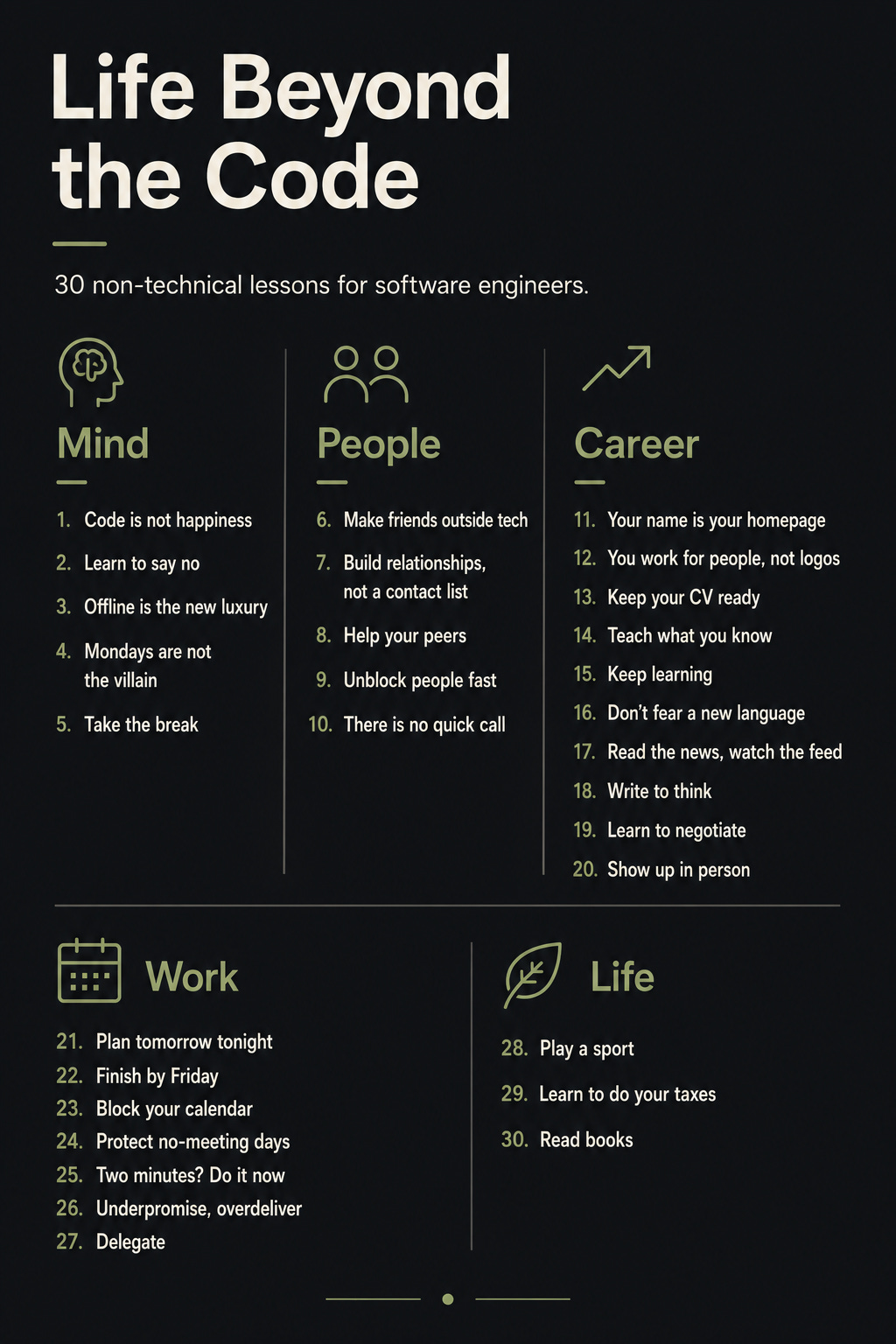
The Point
We sharpen the technical edge because it is measurable. But the things that shaped my career and my peace were never in the codebase.
A life is more than commits and deployments. The relationships, the rest, the curiosity, the boundaries — that is where the growth actually lives.
It is not about writing great code. It is about designing a life worth writing about.
What lesson outside the code shaped you? I would like to hear it.
Originally published on Peerlist, where I write about engineering and life beyond it. Earlier, I wrote about 10 technical lessons from my years as a software engineer — hope it helps.